

Hey there! As a supplier of 8 ton spider cranes, I often get asked about what the load chart of an 8 ton spider crane is. Well, let's dive right into it and break it down in an easy - to - understand way.
First off, a load chart is super important for any crane. It's like a user manual that tells you exactly what the crane can and can't do in terms of lifting capacity. For an 8 ton spider crane, the load chart is a detailed document that shows how much weight the crane can lift at different working radii and boom lengths.
The "8 ton" in the name of the crane doesn't mean it can always lift 8 tons. That 8 ton capacity is usually at a very specific set of conditions, often with a short boom length and a small working radius. As the boom extends and the working radius gets larger, the crane's lifting capacity goes down. This is because the further the load is from the center of the crane, the more leverage is involved, and the crane has to work harder to keep everything stable.
Let's take a look at how these factors interact. When the boom is fully retracted and the load is close to the crane, say at a small radius of just a few feet, the crane can get pretty close to its maximum 8 ton capacity. But as you start to extend the boom out, the load capacity starts to drop rapidly. For example, at a medium working radius of around 10 - 15 feet, the crane might only be able to lift 5 or 6 tons. And if you really stretch that boom out to its maximum length and a large working radius, the lifting capacity could be as low as 1 or 2 tons.
Another thing that affects the load chart is the angle of the boom. A steeper boom angle generally allows for a higher lifting capacity compared to a more horizontal boom. This is because a steeper boom provides better support and reduces the stress on the crane's structure.
Now, why is it so crucial to follow the load chart? Well, safety is the number one reason. Overloading a crane can lead to some really serious consequences. It can cause the crane to tip over, which is not only dangerous for the operators but also for anyone in the vicinity. It can also damage the crane itself, leading to costly repairs and downtime. So, always make sure to check the load chart before you start any lifting operation.
If you're in the market for a crane and think an 8 ton spider crane might be a bit too much or too little for your needs, we also offer other options. For lighter jobs, you might want to check out our 5 Ton Spider Crane. It's a great choice for smaller construction sites or tasks where you don't need to lift extremely heavy loads. On the other hand, if you have some really heavy - duty lifting to do, our 10 Ton Spider Crane could be the way to go.
In addition to these spider cranes, we also have a High Quality Mini Tracked Crane. This mini - crane is perfect for tight spaces where a larger crane just won't fit. It offers great maneuverability and still has a decent lifting capacity for its size.
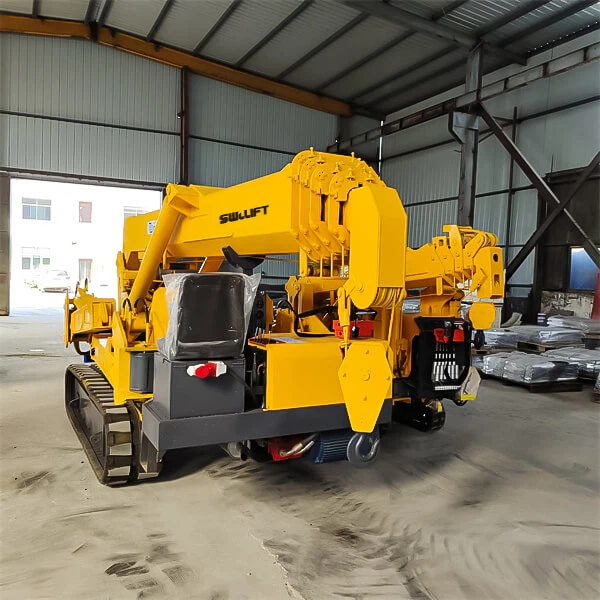

So, how do you read a load chart? It might seem a bit intimidating at first, but it's actually not that hard. Most load charts are presented in a tabular format. The rows usually represent different boom lengths, and the columns represent different working radii. The numbers inside the table show the maximum lifting capacity at those specific combinations of boom length and working radius.
For example, if you want to know how much you can lift with a boom length of 20 feet and a working radius of 12 feet, you just find the corresponding row for 20 - foot boom length and the column for 12 - foot working radius, and the number in that cell is your maximum lifting capacity.
It's also important to note that the load chart might have different sections for different configurations of the crane. For instance, there could be a section for when the crane is on a level surface and another for when it's on an inclined surface. Always make sure you're looking at the right part of the load chart for your specific situation.
When you're using an 8 ton spider crane, you also need to consider the type of load. Different loads have different center of gravity and shapes, which can affect the stability of the crane. Irregularly shaped loads or loads with a high center of gravity might require some extra precautions and might even reduce the effective lifting capacity compared to a standard, evenly distributed load.
In conclusion, the load chart of an 8 ton spider crane is a vital tool for anyone using this type of equipment. It helps ensure that you're using the crane safely and efficiently. Whether you're a construction company, a contractor, or someone involved in a special project, understanding the load chart is key to getting the job done right.
If you're interested in our 8 ton spider cranes or any of our other products like the 5 Ton Spider Crane, 10 Ton Spider Crane, or High Quality Mini Tracked Crane, don't hesitate to reach out. We're here to answer any questions you might have and help you find the perfect crane for your needs.
References:
- Crane Industry Handbook
- Manufacturer's Manuals for Spider Cranes