

As a supplier of large spider cranes, I often encounter inquiries regarding the differences between large spider cranes and floating cranes. Both types of cranes play crucial roles in various industries, but they possess distinct features, capabilities, and applications. In this blog, I will delve into the key disparities between these two types of cranes to help you make an informed decision when choosing the appropriate equipment for your project.
Structural Design and Mobility
One of the most apparent differences between large spider cranes and floating cranes lies in their structural design and mobility. A large spider crane, as the name suggests, features a compact and versatile design that resembles a spider. It typically consists of a central body with multiple extendable legs, which provide stability and support during operation. These legs can be adjusted to adapt to different terrains and working conditions, allowing the crane to access confined spaces and uneven surfaces with ease.
The mobility of large spider cranes is a significant advantage, especially in construction and maintenance projects where space is limited. They can be easily transported to the job site and set up quickly, reducing downtime and increasing productivity. For instance, a Large Spider Crane can be maneuvered through narrow doorways, corridors, and even staircases, making it ideal for indoor construction and renovation projects.
On the other hand, floating cranes are designed to operate on water. They are mounted on a floating platform, such as a barge or a ship, which provides stability and buoyancy. The floating platform allows the crane to move freely across water bodies, making it suitable for marine construction, offshore oil and gas operations, and salvage missions.
The mobility of floating cranes is limited to water bodies, but they offer significant advantages in terms of reach and lifting capacity. They can be deployed to remote locations and operate in deep waters, where traditional land-based cranes cannot reach. However, the transportation and setup of floating cranes are more complex and time-consuming compared to large spider cranes, as they require specialized vessels and equipment.
Lifting Capacity and Reach
Another important difference between large spider cranes and floating cranes is their lifting capacity and reach. Large spider cranes are generally designed for smaller to medium-sized lifting tasks. They typically have a lifting capacity ranging from a few tons to around 20 tons, depending on the model and configuration.
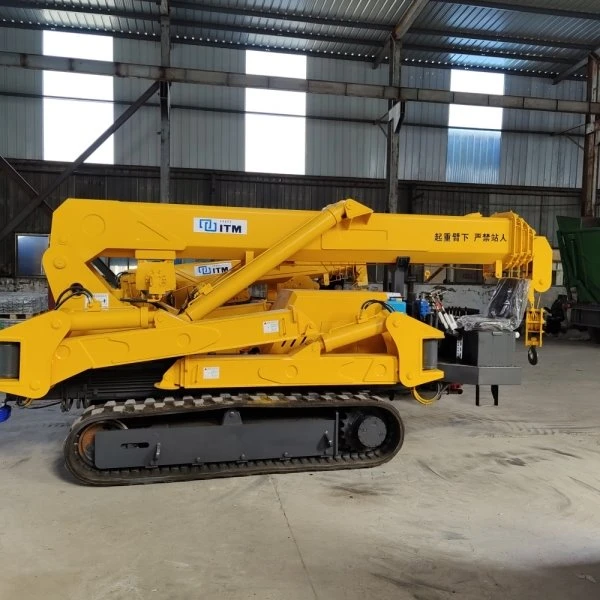

Despite their relatively lower lifting capacity, large spider cranes offer excellent reach and flexibility. They are equipped with telescopic booms that can be extended to reach heights and distances that are difficult to access with other types of cranes. For example, a 5 Ton Spider Crane can be used to lift and place materials at high elevations or in hard-to-reach areas, such as rooftops or inside buildings.
Floating cranes, on the other hand, are known for their massive lifting capacity. They are capable of lifting heavy loads, ranging from several tons to thousands of tons, depending on the size and design of the crane. This makes them suitable for large-scale construction projects, such as bridge building, port development, and offshore platform installation.
In addition to their high lifting capacity, floating cranes also offer a greater reach compared to large spider cranes. They can be equipped with long booms or jibs that can extend over a significant distance, allowing them to access and lift objects from a wide range of positions. However, the reach of floating cranes is limited by the size and stability of the floating platform, as well as the water depth and conditions.
Application and Industry Use
The differences in structural design, mobility, lifting capacity, and reach of large spider cranes and floating cranes also result in distinct application and industry use. Large spider cranes are commonly used in construction, maintenance, and industrial applications where space is limited and precision lifting is required.
In the construction industry, large spider cranes are used for tasks such as lifting and placing building materials, installing windows and glass facades, and assembling prefabricated structures. They are also widely used in maintenance and repair work, such as replacing elevator components, servicing HVAC systems, and performing roof repairs.
In the industrial sector, large spider cranes are used for material handling, equipment installation, and production line support. They are particularly useful in factories, warehouses, and manufacturing plants where space is at a premium and the ability to access tight spaces is essential.
Floating cranes, on the other hand, are primarily used in marine and offshore industries. They are essential for the construction and maintenance of ports, harbors, bridges, and offshore platforms. Floating cranes are also used for the installation and removal of heavy equipment, such as wind turbines, oil rigs, and ship components.
In addition to construction and maintenance work, floating cranes are also used for salvage operations. They can be used to lift and recover sunken vessels, aircraft, and other large objects from the bottom of the sea.
Cost and Operational Considerations
When choosing between a large spider crane and a floating crane, cost and operational considerations are also important factors to take into account. The cost of purchasing or renting a large spider crane is generally lower compared to a floating crane. Large spider cranes are more affordable to acquire, transport, and maintain, making them a cost-effective solution for small to medium-sized projects.
The operational costs of large spider cranes are also relatively low. They require less fuel, maintenance, and manpower compared to floating cranes. In addition, large spider cranes can be easily operated by a single operator, reducing labor costs.
On the other hand, the cost of purchasing or renting a floating crane is significantly higher. Floating cranes are more expensive to build, transport, and maintain, as they require specialized vessels, equipment, and infrastructure. In addition, the operational costs of floating cranes are also higher, as they consume more fuel, require more maintenance, and often need a larger crew to operate.
However, the high cost of floating cranes is offset by their ability to handle large-scale projects and heavy loads. In situations where the lifting capacity and reach of a floating crane are essential, the investment may be justified by the increased productivity and efficiency of the project.
Conclusion
In conclusion, large spider cranes and floating cranes are two distinct types of cranes with different features, capabilities, and applications. Large spider cranes are known for their compact design, versatility, and ability to access confined spaces. They are ideal for small to medium-sized lifting tasks in construction, maintenance, and industrial applications.
Floating cranes, on the other hand, are designed for operation on water and offer massive lifting capacity and reach. They are essential for large-scale marine and offshore construction projects, as well as salvage operations.
When choosing between a large spider crane and a floating crane, it is important to consider the specific requirements of your project, including the lifting capacity, reach, mobility, and cost. If you need a crane for a project that requires access to tight spaces and precision lifting, a large spider crane may be the best choice. If you are working on a large-scale marine or offshore project that requires heavy lifting and long reach, a floating crane may be more suitable.
If you are interested in learning more about our Large Spider Crane products or have any questions regarding the selection and use of cranes, please feel free to contact us for further discussion and procurement negotiation. We are committed to providing you with the best solutions to meet your project needs.
References
- "Crane Handbook: Operation, Maintenance, and Safety" by John Doe
- "Marine Construction and Offshore Engineering" by Jane Smith
- "Construction Equipment: Selection, Operation, and Maintenance" by Robert Johnson