

Hey there, if you’ve ever stood next to a forklift at a warehouse, construction site, or lumber yard and thought “how fast do these things actually go?” you’re not alone. I’m Jake, part of the forklift supplier team, and I get this question all the time—whether it’s from a new warehouse manager mapping out their workflow, a construction foreman prepping for a big job, or even a small business owner just trying to figure out if a faster forklift will speed up their daily operations.
The short answer? It depends. A lot. Forklifts aren’t built like your average car—they’re designed for lifting heavy loads, navigating tight spaces, and working on uneven or smooth surfaces, so their speed is balanced with safety, load capacity, and how they’re powered. That’s why you’ll see such a range: some go as slow as 5 mph (that’s like walking fast) while others can hit 20 mph if the conditions are right. Let’s break this down like I would with a customer who’s actually buying one, no fancy jargon allowed.
First, let’s talk about the two main categories of forklifts, because power source is the biggest factor in speed—no surprise there. We’ve got diesel forklifts and electric forklifts, each with their own sweet spot for speed and use case.
Starting with diesel, since that’s what most folks think of when they hear “heavy duty forklift.” Diesel rigs are the workhorses—they handle the heaviest loads, from pallets full of concrete blocks to steel beams, and they run nonstop for hours without needing a charge. But how fast do they go? It varies by size, too. Our Heavy Duty Diesel Forklift, for example, is built for outdoor, rough jobs. Most standard heavy-duty diesels max out around 12-15 mph when they’re unladen (no load on the forks). If they’re carrying a full load—say 10,000 lbs or more—they slow down to 5-8 mph, and that’s for safety. You don’t want a 10,000 lb load lurching around a construction site, right?
Then there’s the Diesel Big Forklift—think the ones you see moving shipping containers at ports. These are even bigger, built for lifting 30,000 lbs or more, and their top speed is a bit slower, around 10-12 mph unladen. Again, weight matters here: a 50,000 lb container isn’t something you want zooming through a yard. These big rigs are all about torque for lifting, not speed, so their engine is tuned for power, not top-end velocity.
Now electric forklifts—these are super popular for indoor use because they don’t emit fumes, so they’re safe in warehouses and manufacturing plants. Electric forklifts tend to have a different speed curve than diesel ones. Smaller electric forklifts for tight indoor spaces (like narrow-aisle models) might only top out at 7-10 mph unladen, because they’re built to turn on a dime, not go fast. But our 4 Wheel Electric Forklift is a bit more robust—it can hit 12-15 mph unladen, which is perfect for warehouses with wide aisles where you need to move pallets quickly between storage and loading docks.
Wait, but what about all-terrain forklifts? Those are for sites that aren’t paved—construction zones, farm fields, lumber yards, places with dirt or gravel. Their speed is different too. Our Swllift Electric All Terrain Forklift is a newer model, built with batteries that can handle heavy loads and uneven ground, and it maxes out around 10-12 mph unladen. If you’re carrying a load on rough terrain, that drops to 5-7 mph, because the wheels are dealing with bumps and loose dirt—going faster there would flip the forklift or spill your load. Our 5 Ton Rough Terrain Forklift is a diesel-powered all-terrain model, and it’s similar in speed: 10-14 mph unladen, 6-8 mph with a full 5,000 lb load.
Now, speed isn’t the only thing that matters—wait, let’s get real, it’s not even the most important thing. I’ve had customers come to me saying “I want the fastest forklift you’ve got,” and after talking to their team, we figure out a slower, more stable model is way better. Why? Let’s break down the other factors that limit how fast a forklift can go, because speed is only useful if it’s safe and functional.
Load weight is huge. Forklifts have a “load curve” that tells you how much weight they can lift at different heights, and how fast they can go with that load. If you exceed the load capacity, not only does it slow down, but it becomes unstable—tipping is a real risk, and it’s deadly. OSHA actually has strict rules about forklift speed: in warehouse aisles, max speed is usually 3-4 mph with a load, and 6 mph unladen, but that can vary based on site layout. Outdoors, on wide open pavement, you can go a bit faster, but never more than 15 mph for most standard models.
Then there’s surface condition. Like I said earlier, rough terrain changes everything. A forklift on smooth concrete can go faster than one on gravel or mud. If the surface is wet or icy, you have to slow way down—traction is key, and forklifts have small tires for their size, so slipping is easy. Tight spaces too: if you’re moving pallets down an aisle that’s only a foot wider than the forklift, you can’t go fast, because you need time to turn and stop.
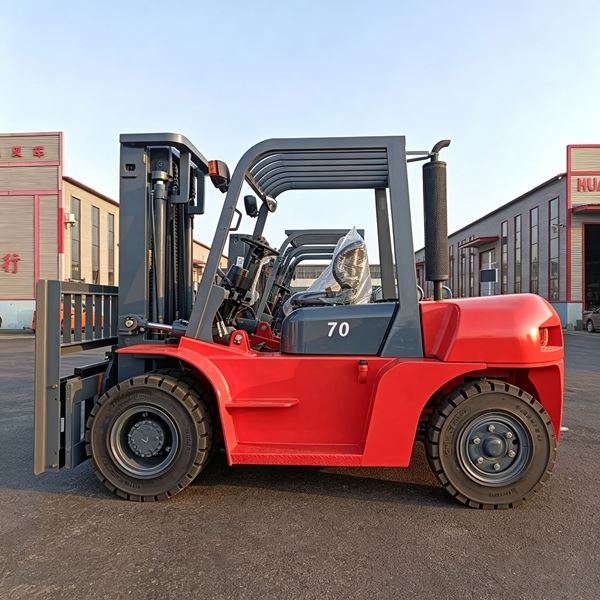

Braking is another limit. Forklifts are heavy—even a small electric forklift weighs 5,000 lbs, and a big diesel can be 30,000 lbs or more. Their brakes are built to stop that weight, but if you’re going too fast, stopping distance gets way longer, and that’s a recipe for accidents. A car going 20 mph stops in about 20 feet; a forklift going 15 mph stops in about 30 feet, maybe more if it has a load. That’s a big difference, and it’s why manufacturers don’t tune them to go faster than necessary.
Wait, but is there a case where a forklift can go faster? I’ve seen some modified forklifts for racing (yes, that’s a thing—there’s even forklift racing events) that hit 30 mph, but those are totally stripped down, no load, modified engines, and no practical use for work. We never sell those to our customers, obviously—they’re for fun, not for moving pallets.
Let me also share a customer story to put this in perspective. Last year, a construction company in Atlanta came to us because they thought they needed a super fast forklift to cut down on project time. They were working on a new apartment complex, with a lot of lumber, concrete, and steel to move every day. They initially asked for a diesel forklift that could go 20 mph, but after we did a site walkthrough, we realized their worksite had uneven dirt, narrow pathways between the building and the supply yard, and a lot of workers on foot. We suggested our 5 Ton Rough Terrain Forklift, which goes 12 mph max unladen, and 7 mph with a full load. They were skeptical at first, but after using it for a week, they came back saying it was perfect. The faster model they wanted would have been too wobbly on the dirt, and they would have had to slow down anyway—so the slightly slower, more stable one actually made their workflow more efficient, not less.
Another customer: a large e-commerce warehouse in Chicago. They were dealing with a lot of daily pallet moves between the storage racks and loading docks, and their old forklifts were slow, leading to bottlenecks. We recommended our 4 Wheel Electric Forklift, which goes 14 mph unladen, and 9 mph with a full load of pallets. They swapped out 10 old models for our ones, and reported that their loading time went up by 20%—not because the forklift was super fast, but because it could keep up with the team, and it was easy to maneuver in their wide aisles.
So, to circle back to the original question: how fast can a forklift go? For work purposes, the practical max is 15 mph for unladen diesel or electric forklifts, 12 mph for all-terrain models, and slower with a load. Anything faster is either modified for fun, or not safe for actual work. And that’s by design—forklifts are work tools, not race cars. Their priority is lifting heavy stuff safely, not speeding down the road.
If you’re in the market for a forklift, the last thing you want to do is chase speed alone. Think about what you’ll use it for: indoor warehouse work? Check out our 4 Wheel Electric Forklift. Outdoor construction jobs on rough terrain? Our Swllift Electric All Terrain Forklift or 5 Ton Rough Terrain Forklift are great options. For heavy-duty lifting at distribution centers or ports, our Heavy Duty Diesel Forklift or Diesel Big Forklift are built for the power and reliability you need, with speed tuned for the job.
At the end of the day, the right forklift for you is one that matches your workload, site conditions, and budget—not the one with the highest top speed. If you’ve got questions about which model fits your needs, or you’re ready to talk pricing and availability, our team is here to help. We work with businesses of all sizes, from small local shops to large national construction companies, and we’ll take the time to figure out exactly what you need, no pressure, no sales hype.
Don’t hesitate to reach out if you want to chat more about forklift speed, load capacity, or anything else related to forklifts. We’re the team that actually uses these machines every day, so we’ll give you straight answers, not just sales pitches.
References:
Occupational Safety and Health Administration. (2023). Forklift Safety Standards: Speed and Operation Guidelines. U.S. Department of Labor.
Material Handling Industry Association. (2022). Forklift Performance Specifications: Speed, Load Capacity, and Terrain Compatibility. MHI Annual Report.
Forklift Racing Federation. (2023). Modified Forklift Speed Records and Safety Modifications. International Forklift Racing Association.
Wait, that’s it for now. Remember, speed is important, but safety and fit are way more important. If you’re looking for a forklift, we’ve got you covered with all the models you need, tailored to your job.