

If you’ve ever walked past a warehouse yard or a construction site early in the morning, you’ve probably heard that deep, rumbling growl of a diesel forklift waking up. Most people just see the big machine lifting pallets or stacking supplies, but very few stop to think about what makes that initial start-up even possible. As a diesel forklift supplier, I get asked this question all the time: “What’s the big deal with the starter motor? It’s just a motor that turns the engine, right?” Yeah, that’s part of it, but there’s way more to it—especially for diesel models, which are way different from gas or electric forklifts. Let’s break this down like I would explain it to a regular guy or girl who’s used these machines but never thought about how they actually start.
First, let’s get one thing straight: diesel engines don’t work like gas ones. Gas engines mix fuel and air, then use a spark plug to light it off. No spark plugs = no fire. Diesel engines, though, are compression-ignited. That means they compress the air inside the cylinders so much that it gets super hot—like, 1,000 degrees Fahrenheit hot— and when you inject diesel fuel into that, it catches fire all on its own. The problem? You can’t compress the air that hot all by yourself without turning the engine first. That’s exactly where the starter motor comes in. Its whole job is to crank the engine over fast enough to get that compression going. Without a good starter, even the newest diesel big forklift sitting in your yard isn’t gonna budge.
Let’s get into the nitty-gritty of how that works. When you turn the key (or hit the start button, which most modern forklifts use now), a bunch of tiny electrical parts kick in. First, the ignition switch sends a signal to the starter solenoid—that’s like a traffic cop for electricity. The solenoid’s job is to connect the big battery cables (which hold tons of power) to the starter motor itself. Once that link is made, the starter’s internal gear (called a pinion gear) pops out and locks onto the flywheel gear on the back of the engine. It’s kinda like when you push a bike’s pedal to start rolling, but here, the starter is the one doing the pushing, and the flywheel is the big heavy wheel attached to the engine. The starter spins that flywheel really fast—usually between 150 and 250 RPM, depending on the forklift—until the engine’s pistons can start compressing air on their own. Once the engine is running, a sensor tells the solenoid to pull the pinion gear back out, so it doesn’t grind against the flywheel later on when the engine’s running on its own power.
Now, here’s why starter motors are extra critical for diesel forklifts compared to other types. Electric forklifts don’t need big engines—they’re just electric motors that drive the wheels, so they start instantly with a flip of a switch. Gas forklifts have spark plugs, which means you can get away with a weaker starter sometimes, but diesel’s compression ignition needs that fast cranking to build enough heat. If your starter is weak or worn out, you’re gonna have trouble starting your 3.5 ton diesel forklift on cold mornings, or even after it’s been sitting for a day. I’ve seen this happen so many times with customers who ignore their starter maintenance—they come to us with a dead forklift at 6 a.m. and a whole delivery schedule backed up because their starter couldn’t turn the engine over fast enough.
What makes a good starter motor for a diesel forklift, anyway? It’s not just a one-size-fits-all part. The size and power of the starter depends on the forklift’s weight and engine size. A heavy duty diesel forklift with a big 6-cylinder engine needs a way stronger starter than a small compact model used in a grocery store stock room. That’s why when we stock our inventory, we match starters to each forklift model—like our Swllift 5 ton diesel forklift uses a 12V, 4.5kW starter, while our smaller 3.5 ton model uses a 12V, 3kW one. If you put a too-weak starter on a big diesel engine, it’ll struggle to crank, wear out way faster, and leave you stranded.
Starter motors also have a pretty tough job, so they don’t last forever. Most starters for diesel forklifts last between 30,000 and 60,000 starts, but that depends on how you use them. If you’re constantly cranking the engine for 10 seconds at a time because you’re trying to start it in cold weather, that’s way harder on the starter than a quick 2-second crank every morning. Also, things like dirty battery terminals, low battery voltage, or corroded wiring can make the starter work way harder than it should, shortening its life. I always tell customers: if your starter is making a grinding noise when you start it, or it takes longer than usual to turn the engine over, don’t wait until it dies completely. A replacement starter is way cheaper than missing a big delivery because your forklift won’t start.
Another thing most people don’t realize: the starter motor is part of a whole start system, not just a single part. It works with the forklift’s battery, alternator, ignition switch, and solenoid. If one of those parts is off, the starter won’t work right. For example, if your battery is only holding 11V instead of the required 12.6V for a fully charged battery, the starter won’t get enough power to crank the engine fast enough. I’ve had customers come to me saying their starter is broken, but it turns out their battery was dead because they left the lights on overnight. That’s why it’s important to check the whole start system, not just the starter itself, when you’re having starting issues.
Let’s talk about some common starter problems that pop up with diesel forklifts. The first one is a “no start” when you turn the key. That could be a dead battery, a bad solenoid, or a completely dead starter. Another common issue is a starter that spins but doesn’t crank the engine. That’s usually when the pinion gear isn’t locking onto the flywheel correctly, which could be because the starter’s gear is worn out, or the flywheel’s teeth are chipped. I once had a customer whose 5 ton hydraulic diesel forklift had a bad flywheel tooth—we had to replace both the flywheel and the starter, because the worn tooth had damaged the starter’s pinion gear. The third problem is a grinding noise when starting. That’s when the pinion gear is grinding against the flywheel because it’s not retracting fast enough, which can damage both parts if you keep trying to start it.
Now, as a supplier, I always emphasize that choosing the right starter matters just as much as choosing the right diesel forklift. A lot of customers try to save money by buying aftermarket starters that aren’t made for their specific model, but those often don’t hold up. OEM (original equipment manufacturer) starters are designed to work with the exact engine and specs of our forklifts, so they’re more reliable. For example, all the starters we use for our diesel big forklift line are tested to handle the high compression of big diesel engines, so they’re way less likely to fail in tough work environments like construction sites or lumber yards.
Proper maintenance of the starter motor can save you a lot of money in the long run. Here’s a quick checklist I give to all my customers: first, check the battery terminals every month—clean off any corrosion with a wire brush and make sure they’re tight. Second, test the battery voltage every 3 months—if it’s below 12.4V, charge it or replace it. Third, listen to the starter when you start the engine—if it sounds slow or makes weird noises, get it checked before it dies. Fourth, don’t crank the engine for more than 10 seconds at a time; wait 30 seconds between cranks to let the starter cool down. I see so many people hold the start button for 20 seconds straight, which is a quick way to burn out a starter.
Wait, let’s also clear up a common myth: some people think the alternator powers the starter. No way— the alternator’s job is to charge the battery when the engine is running. The starter only uses power from the battery to crank the engine. Once the engine is running, the alternator takes over to power the forklift’s electronics and recharge the battery. That’s why if your alternator is bad, your battery will die, and then your starter won’t have power, so the engine won’t start. It’s a chain: battery → starter to start engine → alternator charges battery for next time.

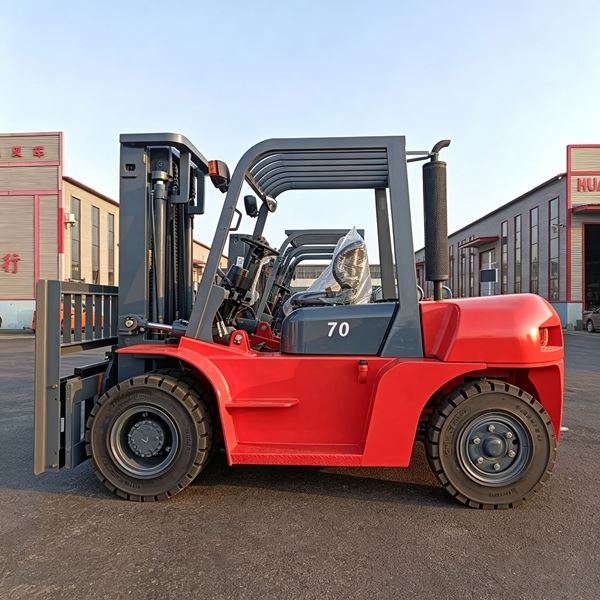
Another thing that’s become more common lately with newer diesel forklifts: starters with gear reduction. These are way more efficient than old-style direct drive starters. Gear reduction starters have a small gear inside that spins faster than the main pinion gear, so they can produce more torque without being as big or heavy. That’s perfect for our heavy duty diesel forklift models, which need a lot of torque to crank their big engines without adding extra weight to the forklift. No one wants a forklift that’s too heavy to lift as much as it’s rated for, so gear reduction starters are a game-changer for that.
Let me give you a real example from a customer of mine. Last winter, a construction company in Chicago came to us because their Swllift 5 ton diesel forklift was having trouble starting every morning when it was below freezing. They had been using a cheap aftermarket starter, and it couldn’t produce enough torque to crank the engine fast enough in the cold. We replaced it with an OEM starter made for that model, and they haven’t had a problem since. They said it’s saved them hundreds of dollars in downtime because they don’t have to delay deliveries or pay for emergency service calls at 5 a.m. That’s exactly why getting the right starter is such a big deal— it’s not just a part, it’s what keeps your operation running smoothly.
So, wrapping this up, the starter motor’s role in a diesel forklift isn’t just “turn the engine over.” It’s the reason that compression ignition is possible, it’s the link between your battery and your engine, and it’s a critical part that has to be matched to your forklift’s size and use. If you’re in the market for a diesel forklift, make sure you’re not just looking at lift capacity or price—ask about the starter motor specs too, because that’s what will keep your forklift starting when you need it. If you’re having trouble with your current forklift’s starter, don’t hesitate to reach out. We’ve got all the parts you need for our full line, from the 3.5 ton diesel forklift to our heavy duty models, and we can help you pick the right starter for your needs.
References
- Diesel Equipment Manufacturers Association. (2022). Starter Motor Requirements for Compression-Ignition Engines.
- Forklift Safety Council. (2021). Preventive Maintenance Guidelines for Diesel Lift Trucks.
- Automotive Service Association. (2020). Common Starter Motor Failures in Commercial Vehicles.
- Industrial Truck Association. (2023). Diesel Forklift System Components and Performance.