

Hey there! As a supplier of vertical mast lifts, I'm super excited to dive into how the remote control function on these machines works. Vertical mast lifts are pretty awesome pieces of equipment, and the remote control feature takes their usability to a whole new level.
Let's start with what a vertical mast lift is. A vertical mast lift is a type of aerial work platform that's designed to lift workers and equipment vertically. It's great for tasks like maintenance, installation, and construction in places where you need to reach up high. You can check out our Vertical Mast Lifts on our website to get a better idea of the different models we offer.
Now, onto the remote control function. The remote control on a vertical mast lift serves as a convenient way to operate the lift from a distance. This is especially useful in situations where the operator needs to be outside the platform to guide the lift into position or to keep an eye on the surrounding area.
How the Remote Control Communicates with the Lift
The remote control uses a wireless communication system to send signals to the lift. Most modern vertical mast lifts use radio frequency (RF) technology for this purpose. RF signals are a type of electromagnetic wave that can travel through the air and penetrate some obstacles. The remote control has a transmitter that sends out these RF signals, and the lift has a receiver that picks them up.
When you press a button on the remote control, the transmitter encodes the corresponding command into an RF signal. This signal is then sent out into the air. The receiver on the lift is constantly scanning for incoming RF signals. Once it detects a signal from the remote control, it decodes the signal to figure out what command was sent.

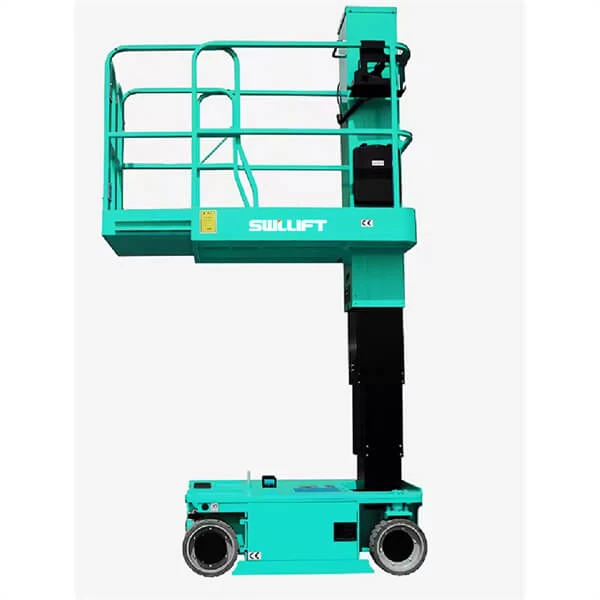
For example, if you press the "up" button on the remote control, the transmitter will send an RF signal indicating the "up" command. The receiver on the lift will decode this signal and then activate the hydraulic or electric system that raises the platform.
Safety Features in the Remote Control System
Safety is a top priority when it comes to operating vertical mast lifts. That's why the remote control system is equipped with several safety features.
One of the most important safety features is the emergency stop button. This button is usually large and easy to press, and it's located in a prominent position on the remote control. If something goes wrong during operation, the operator can quickly press the emergency stop button. When this button is pressed, the transmitter sends an emergency stop signal to the lift. The receiver on the lift will immediately cut off power to all the moving parts of the lift, bringing it to a halt.
Another safety feature is the signal strength indicator. The remote control usually has a display or a set of lights that show the strength of the RF signal between the remote control and the lift. If the signal strength is too weak, it could mean that there's an interference or that the remote control is too far away from the lift. In this case, the operator should move closer to the lift or check for any sources of interference.
Types of Commands You Can Send with the Remote Control
The remote control allows you to perform a variety of commands on the lift. Here are some of the most common ones:
- Vertical Movement: You can use the remote control to raise and lower the platform of the lift. This is useful for reaching different heights during a job.
- Horizontal Movement: Some vertical mast lifts also have the ability to move horizontally. The remote control allows you to move the lift forward, backward, left, or right.
- Platform Rotation: In some models, you can rotate the platform of the lift using the remote control. This gives you more flexibility in positioning the platform.
Advantages of Using a Remote Control
There are several advantages to using a remote control on a vertical mast lift.
First of all, it improves safety. As I mentioned earlier, the operator can stand outside the platform and keep an eye on the surrounding area. This helps to prevent accidents by allowing the operator to quickly spot any potential hazards.
Secondly, it increases efficiency. With the remote control, the operator can position the lift more precisely. They can move the lift into place without having to constantly get in and out of the platform. This saves time and makes the job go more smoothly.
Our Single Mast Lift and 26 ft Vertical Mast Boom Lift
We offer a wide range of vertical mast lifts, including the Single Mast Lift and the Vertical Mast Boom Lift 26 ft.
The single mast lift is a compact and lightweight option that's perfect for indoor use. It's easy to maneuver and can fit through narrow doorways and aisles. The remote control function on the single mast lift makes it even more convenient to operate, especially in tight spaces.
The vertical mast boom lift 26 ft, on the other hand, offers a greater working height. It's ideal for outdoor construction and maintenance projects. The remote control allows you to position the platform at the right height and angle with ease.
Conclusion and Call to Action
In conclusion, the remote control function on a vertical mast lift is a game-changer. It provides a convenient and safe way to operate the lift, and it can significantly improve efficiency on the job site.
If you're in the market for a vertical mast lift, we'd love to hear from you. Our team of experts can help you choose the right model for your needs and answer any questions you might have. Whether you're a small business owner or a large construction company, we have the perfect vertical mast lift for you. So, don't hesitate to reach out and start the conversation about your next purchase.
References
- OSHA Guidelines for Aerial Work Platforms
- Manufacturer's Manuals for Vertical Mast Lifts