

Hey there! As a supplier of 8 ton spider cranes, I'm super excited to take you through how the outrigger system on these bad - boys works. You see, the outrigger system is like the unsung hero of the 8 ton spider crane. It's what gives this machine the stability it needs to lift those heavy loads safely and efficiently.
Let's start with the basics. An 8 ton spider crane is a beast when it comes to lifting capacity. But without a proper outrigger system, it would be like a tightrope walker without a safety net. The outriggers are essentially the legs of the crane that extend outwards from the main body. They come in different shapes and sizes, but the main goal is always the same: to increase the crane's base of support and prevent it from tipping over.
So, how exactly do these outriggers work? Well, it all begins with the hydraulic system. Most 8 ton spider cranes, including the ones we supply, use a hydraulic system to operate the outriggers. Hydraulics are amazing because they can generate a whole lot of force using a relatively small amount of fluid.
When you activate the outrigger system, hydraulic pumps start pumping hydraulic fluid into cylinders attached to the outriggers. As the fluid enters the cylinders, it pushes a piston inside. This piston is connected to the outrigger beam, and as it moves, it extends the outrigger outwards. It's like a mechanical arm reaching out to grab a better hold on the ground.
Once the outriggers are extended to the desired position, the next step is to level the crane. This is crucial because if the crane isn't level, it can put uneven stress on the structure and increase the risk of tipping. Our 8 ton spider cranes are equipped with level sensors that can detect even the slightest incline. The operator can then use the hydraulic system to adjust the height of each outrigger individually until the crane is perfectly level.
Now, let's talk about the different types of outriggers you might find on an 8 ton spider crane. There are two main types: telescopic outriggers and fixed - length outriggers.
Telescopic outriggers are pretty cool. They can be extended to different lengths, which gives you a lot of flexibility when it comes to setting up the crane. You can adjust the length of the outriggers depending on the space available and the load you're going to lift. For example, if you're working in a tight space, you might not be able to extend the outriggers fully. But if you have plenty of room, you can extend them all the way to maximize the crane's stability. You can check out some of our models with telescopic outriggers on our Mini Spider Crane page.
Fixed - length outriggers, on the other hand, have a set length. They're simpler in design and can be more cost - effective. They're great for situations where you know exactly what the setup requirements are and don't need the extra flexibility of telescopic outriggers. Our Crawler Spider Crane models sometimes come with fixed - length outriggers, which are perfect for certain types of jobs.
Another important aspect of the outrigger system is the outrigger pads. These are large, flat plates that are placed under the outrigger feet. The purpose of the outrigger pads is to distribute the weight of the crane over a larger area. This helps prevent the outriggers from sinking into soft ground, which could compromise the crane's stability.
The material of the outrigger pads is also important. They're usually made of high - strength materials like steel or composite materials. Steel pads are very durable and can handle heavy loads, but they're also quite heavy. Composite pads, on the other hand, are lighter and easier to handle, but they still have enough strength to support the crane.
When setting up the outrigger system, it's not just about extending the outriggers and leveling the crane. You also need to make sure that the ground is suitable. The ground should be firm, level, and free of any debris or obstacles. If the ground is too soft, you might need to take additional measures like using thicker outrigger pads or compacting the ground.
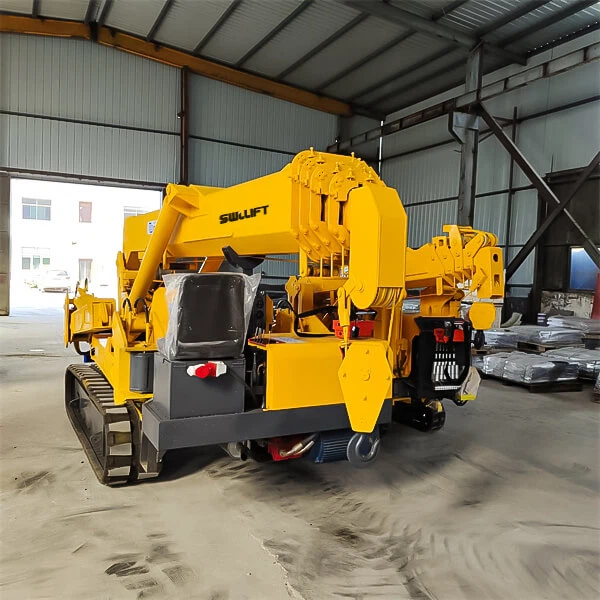

Now, you might be wondering how the outrigger system on an 8 ton spider crane compares to other cranes. Well, compared to larger, more traditional cranes, the outrigger system on a spider crane is more compact and versatile. Spider cranes are designed to work in tight spaces, so their outriggers are often more maneuverable. They can be set up quickly and easily, which is a huge advantage on job sites where time is of the essence.
But don't think that just because the 8 ton spider crane is more compact, it's any less powerful. With the right outrigger setup, it can lift just as much as larger cranes in many situations. And if you need even more lifting capacity, we also offer 10 Ton Spider Crane models that have even more robust outrigger systems.
In conclusion, the outrigger system on an 8 ton spider crane is a complex but essential part of the machine. It provides the stability needed to lift heavy loads safely and efficiently. Whether you're working in a small indoor space or a large outdoor construction site, the outrigger system can be adjusted to meet your specific needs.
If you're in the market for an 8 ton spider crane or have any questions about the outrigger system or our other products, don't hesitate to reach out. We're here to help you find the perfect crane for your job and make sure you get the most out of it.
References
- Crane Operator's Manuals
- Industry - standard Crane Safety Guidelines